Monday, November 24, 2008

A "Sick Man of Asia" Speaks His Mind in England

Bill Brown ... Xiamen University

Lu, C.C., of Ningpo, China “China and England: a Lecture Delivered at Sheffield University,” Sheffield Independent Press, Sheffield, U.K., 1904

Short bio: Studied in Japan and England. Mother, with Mrs. Archibald Little, organized the Anti-Foot-Binding Society in Shanghai and Ningpo. Father, formerly the general officer of a steamer, was then the general manager of China’s greatest colliery.

Seldom if ever have I enjoyed such pleasure as I feel at being privileged to speak, imperfect as it may be, on my native country before such an audience. But being a world-despised Chinaman, I could not help feeling when I cast my eyes upon myself how unworthy I am for such a great honour. Nevertheless I am unwilling not to make use of this great chance and say something which I hope may lead us to understand each other more and better.

Since I came to this country, I have found that most of the people here in England have a very poor idea of the Chinese, in other words, you think we are barbarians or uncivilized people. China has been dubbed "The sick man of the Far East," "The Sleeping Lion," "The Tottery Empire," and other names more or less picturesque and complimentary have been bestowed upon her.

With some people, it is the conviction that China has only a historical interest, that her glory is of the past that the leopard may change its spots, but China remains for ever in her ruts ; the same yesterday, to-day, and to-morrow. But while this gloomy picture of the state of affairs might have been partly true of China in the time past, it is no longer true now. The sick man is rapidly convalescent, the sleeping lion is awake, and the hoary and tottery empire has had new blood injected into her system. China is moving and she is moving with a rapidity difficult for one who has not personally witnessed the wonderful changes to understand and realise.

Repeated defeats at the hands of the foreign Powers soon convinced our people of the futility of matching bows and arrows against modern guns and explosives, whilst our wooden junks went down before the onslaught of armoured cruisers and battleships like wheat before the scythe….

In passing, I may say that all the books written by the foreign authors on China as she is are mostly out of date, with the exception of a very few published in recent years. These books have only a historical value now, and can no longer be regarded as guides or indexes of the situation in the Far East. The changes that have taken place are kaleidoscopic in rapidity and mysterious in character, so that even a native of the land, unless he is a keen observer, gets bewildered and is left behind in the swiftly moving onward progress of my country.

Lu, C.C., of Ningpo, China “China and England: a Lecture Delivered at Sheffield University,” Sheffield Independent Press, Sheffield, U.K., 1904

As you know, not many years ago, your Indian traders sent opium to our country. We observed that the use of the drug was destroying the health and morals of our people, and therefore we prohibited it. But to please your traders your Government made our action an excuse for war. Was this calculated to impress us with a sense of the justice and fair play of the British Nation? We submitted because we had to, we were not a military Power. "The Chinese believe in right," said Sir Robert Hart honestly, “so firmly that they scorn to think it requires to be supported or enforced by might." Yes, it is we, who do not accept it, that practise the Gospel of Peace; it is you who accept it who trample it under foot. And, irony of ironies, it is the nation of Christendom who have to come to us to teach us by sword and fire that right in this world is powerless unless it be supported by might! You have posed as civilized people dealing with barbarians, and this has been your conduct. First you compelled us to receive your missionaries, and when they provoked our people by their ignorant zeal to rise against them you made this an excuse for new depredations, till we not unnaturally have come to believe that the Cross is the pioneer of the sword, and that the only use you have for your religion is as a weapon of war. O, my dear brethren! let me cry out and tell you! "Christianity is a doctrine which is not only for you to believe, to listen to, to read on Sunday in church, but to act according to it at any time and everywhere!"

Listen to my uncle, Dr. Suvong's words. He wrote me and said:"My dear nephew The first thing for a man is to be good, the second is to do good, and then the good God in heaven will reward here and hereafter." These words which I have heard from the East are the true doctrine of Christ, and though we do not preach it, yet we perform it as our duty.

www.amoymagic.com

Chinese Children in Old Amoy

Bill Brown .... Xiamen University

From John Macgowan, Sidelights on Chinese Life, 1907 p. 44, 50
THERE is no nation that is fonder of children than the Chinese. They have a perfect passion for them, and it is very rarely that a family can be found without one or more of them in it. If there are none born into it, arrangements are made to supply that deficiency by buying some for the Chinese seem to have a perfect dread of a childless home. If a man has the means, he will buy several sons, who are treated as though they were his own, and, when they grow up, they will inherit his property, and have all the privileges that are given to those that were born in the family….

The early years of a child seem on the whole to be happy ones. In the swarms of children that one sees almost anywhere, one gets the impression that on the whole they thoroughly enjoy themselves. They run about and romp and dance and gambol very much as a similar number of English children would do on the village green, or in the streets and lanes of a home city.

The Chinese are far from being a gloomy race of people. Their hearts are full of fun and vigorous life, and this is seen in the sturdy urchins that race about with each other and that fill the air with their merry sounds of childish laughter.

With very young children this is all the more remarkable since so little is provided for their amusement. Such things as pictures or story-books or toys in the large and profuse sense with which our nurseries are supplied in England, do not exist in this land. Childhood is left very much to its own resources to find out the means of passing the time pleasantly. It is pathetic to watch how, with the fewest and simplest materials, the little ones will pass the day, with apparently perfect contentment. The method most popular, because it involves no expense, is the making of mud pies, and the building of miniature houses with broken pieces of tiles that can be picked up from the streets.

EDUCATION
Macgowan, Sidelights on Chinese Life, 1907, pp. 56, 57

At about eight preparations are made for the lad to go to school. Terms are made with the school-master of the nearest school, a certain number of books splashed and dotted over with mysterious-looking hieroglyphics are bought, and one morning at early dawn, just as the pale grey light begins to colour the landscape, the little fellow finds his way along the silent road to the school-house. Here for six or seven years he will spend the best part of his days in the study of books that contain the ideals of the nation.

They are the driest of dry books, and were really written for scholarly men, and for men of thought, whose thinking powers were considerably developed. There is not a single story in their pages. No child or woman's voice is heard from beginning to end, and no laughter, and no sob of pain, or any touch of the finer qualities of the human heart.

The boy begins at eight not with "Jack and Jill," or the “House that Jack built," or with any nursery rhyme that would appeal to a child's imagination, but with the solemn statements on high ethical questions that some of the greatest thinkers and teachers of China have produced. Some idea of the style of the books that these little urchins have to grind at, may be gathered from the fact that the first book that is put into the hands of that eight-year-old scholar is called The Three Words Classic, from the fact that each sentence is made up of three words rhythmically set. It is about as crabbed and as profound a piece of writing as exists in the whole language. Its first sentence makes a dogmatic statement which has not been generally accepted in China, viz. "Man by nature is originally good." Just imagine a boy of ten, accustomed till to-day to run as wild as a climbing plant, that creeps up trees, or over ruined walls, or down the side of a precipice, brought face to face with a statement like this, instead of the conventional one, " My dog," or "'His cat," that confronts the English lad as he first enters the domain of learning.

Try and conceive the wear and tear upon a child's spirit in having for years to shout and scream out at the top of his voice, as Chinese scholars do, such profound teaching as the above, and you will then have caught a glimpse of the steep and precipitous way along which these eight-year scholars have to travel in their pursuit after knowledge. A more dreary system of education, where imagination and humour, and poetry and romance, and all the finer emotions of the soul are rigorously excluded, it would be impossible to conceive than that which every Chinese scholar has to go through in every school throughout the Empire to-day.
www.amoymagic.com

U.S. Consul in Amoy, Edward Bedloe, on Cemeteries

Bill Brown ... Xiamen University

Ancient Amoy Cemeteries
Bedloe, Edward, M.D., U.S. Consul, reporting in “Weekly Abstract of Sanitary Reports,” Supervising Surgeon-General M.H,S., Government Printing Office, Washington, 1893

January 1, 1881 Public health reports (1881(, v, 2, 1887; U.S. Consul Edward Bedloe, M.D., reported,

The city [Amoy] is built on the edge of a mountainous island and is exceedingly old. Inscriptions on ancient tombs run back as far as the beginning of the Christian era, and coins found in accidentally discovered graves date to dynasties from 500 to 1000 B.C.

During all this period the hillsides of the city have been used as burying grounds. As the population increases, the houses encroached upon the cemetery land until finally the two became hopelessly intermixed.

The United States consulate is regarded as a very superior locality, but it is surrounded by over a hundred tombs. A score of the large blocks of granite used in and about it are old tombstones. On the hill immediately behind the residence of F. Malcampo, esq., the graves touch one another at every point and form a solid white surface of rock, brick, porcelain, and cement, covering more than a million square feet. Near the lam-paw-do Joss-house [Nanputuo Temple] 30,000 bodies are said to have been buried vertically to save space. They lie or stand in a plot of land of as many square feet. Amoy proper and its suburbs have a living population of about one million, and a dead one of four and a half times as many.

The city is a relic of the past. It is walled the same as it was in the time of Confucius.

Note: Amoy wasn’t walled until 2000 years after Confucius' death. And I doubt Amoy has any graves that old. But other than that.... Bedloe had some fascinating points.


www.amoymagic.com

Monday, October 6, 2008

"Everyday Life in China", by Dukes 1885


I have well over 100 0ld books on China, but Dukes' "Everyday Life in China" is one of my favorite because of the dozens of quaint woodcuts--though I think people weren't too hip on copyright back then. Either he stole some, or others stole his, because I've seen a couple in other books, without reference to their origin. The same goes for photos; I've seen several old black and white photographs of Amoy, or the Amoy Mission, reproduced in several books, and rarely with reference to who took the photos.

Below are a few of the woodcuts. When I have time I'll upload the entire book, text and illustrations, onto the Amoy Mission section of our Amoy Magic website.

Dukes, Edwin Joshua, “Everyday Life in China; or, Scenes Along River and Road in Fuh-Kien,” London Missionary Society’s Edition, The Religious Tract Society, 56, Paternoster Row; 65, St. Paul’s Churchyard; and 164, Piccadilly, 1885

Bill Brown Xiamen University www.amoymagic.com

Wednesday, September 24, 2008

Constance Anderson in Foochow


John and Jennifer Anderson will be visiting Xiamen and Fuzhou from October 1st to 30th,2008, to learn more about his roots (he was born in Hope Hospital, Xiamen).

Here is a description (written by Jennifer) of Connie's work. If anyone has more info on Constance, please send it to me, and I will forward it to the Andersons (photos are welcome too).

Constance Anderson
An English Medical Missionary in Fuzhou (1925-1936)
(provided by Jennifer Anderson)

Constance Mary Hopkinson (Sister Hopkinson or Miss Hopkinson), was
born at Tunbridge Wells, England, in 1895. She was a missionary nurse
in Fuzhou between 1925 and 1936 with the CMS (Church Missionary
Society). The information presented here is from her diaries
supplemented by family tradition.

She worked mainly at a hospital called Cha-Cang, which also had the
name Christ̢۪s Hospital. It was not far from the North Gate. Her
supervisor at the Hospital was Miss Margaret Baldwin, who had been a
missionary nurse in Fuzhou since 1901. The CMS had a number of
hospitals, Dragon Hill Hospital, one near the South Gate, and another
on the island of Nantai, which is where many of the foreign
missionaries were located. The CMS ran a number of schools on Nantai
as well as the Anglo-Chinese Girls̢۪ School, also near the South Gate.

The Cha-Cang Hospital treated both paying and nonpaying patients and
also trained nurses. It consisted of separate hospital buildings for
men and women, a tuberculosis ward, and an out-patient department.
There was a chapel and houses for the hospital staff, including the
nurses, to live in. These buildings were all in a gated compound.
Nearby was a school for Blind children. Outside the West Gate there
was a leper settlement where the missionaries visited and provided
some care.

Cha-Cang Hospital was looted on January 16, 1927. Therefore we do not
have the diaries for Connie̢۪s first two years in China. After the
period of unrest in late December of 1926 and early 1927 the
missionaries left the city and did not return until 1928. During this
time the hospital at Cha-Cang was run by the Chinese staff alone.
When Miss Baldwin returned she worked on rebuilding the missionary
work as well as completing the building of new hospital buildings
that was not quite finished in early 1927. Because of these events
most of the information we have about Connie̢۪s work in Fuzhou is
from 1930-1934.

In this period at Cha-Cang she worked with Dr Nga, Dr Ding and Dr
Lau, and two nursing sisters, Sister Chai and Sister Lau. Among the
missionaries at the hospital Sister Giles, Dr Matthews and Dr Callum,
as well as Dr Webster, and later Miss Webster who did nursing work.
Student nurses were trained there, and Miss Hopkinson mentions
teaching and conducting examinations, as well as graduation
ceremonies. She also mentioned two Chinese Pastors, Pastor Do and
Pastor Uong with whom the missionaries at Cha-Cang worked closely.

Most of the years that Constance Hopkinson was in China, she went to
the mountain resort of Kuliang for a summer holiday, along with
missionaries from other parts of China. There, in August 1936, she
met Peter Anderson, from the English Presbyterian Mission in Amoy/ Kulangsu. They were married Nov 10, 1936 in British Episcopal Church
on Nantai Island and she went to live on Kulangsu with him.

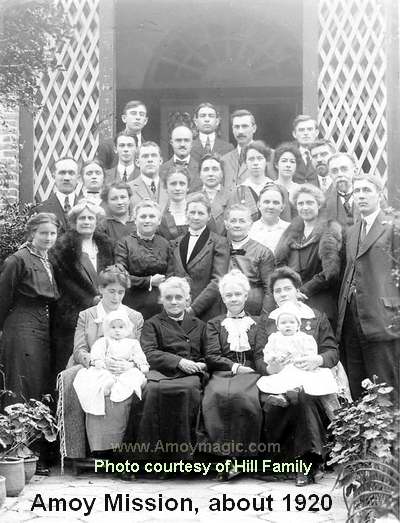
Link: The Amoy Mission

Wednesday, September 17, 2008

19th Century Chinese Dogs

In "Off the Wall" today, I wrote "Why Chinese Dogs are Shy." I'm not the first to write about Chinese dogs. Here are comments about Chinese dogs from the 1880s and 1890s.

Shore, 1881, Flight of the Lapwing, pp. 34, 35
"The only members of the community who showed any resentment to our advances were the dogs, wretched mangy brutes, which infest all Chinese dwellings, and arrant cowards. They seem to have an instinctive dread of Europeans, and scent them a long way off; one has only to bend down as if for a stone and the curs are off like the wind."

Davis, Rev. J.A., “The Young Mandarin; a Story of Chinese Life” Congregational Sunday-School and Publishing Society, Boston and Chicago, 1896 p. 147,148

"The street dog, however, if stories regarding him are true, is the genius and fool in the Chinese animal world. Though born pretty, his hard life makes him a homely brute before a year passes; and he continues to grow more and more ugly in looks while life lasts. Fortunately, for other reasons, too, he is not long-lived. His color in early days may be black or white, yellow or brown; in a year or two it changes to the standard - shaded dirt. His hair, that in youth gives him the appearance of a wolf or coyote, is sacrificed in battles, and scars appear instead. Peaceable by nature, he is born for war, and fights for his living. If he have a master, he learns the fact rather through kicks and blows than caresses and kindness. Owned or ownerless, he must find his own food or prove himself unworthy a place among the living. Of course some receive better treatment at the hands of masters; the description applies to the vast majority.

"The dog of the street is not an unmixed evil, for he is the city scavenger. He never deserts his post unless driven away; never shirks his duty; never goes on a strike; always hungry, usually starving, he allows no food to waste, nothing eatable to decay. Without him epidemics might be far more common than now; yet his only reward comes in kicks and curses. It is said, in some places, the writer has reason to believe with truth, that the street dogs have a government of their own, and each brute knows his place and keeps it. Certainly it was almost impossible to coax, very difficult to force, a dog beyond certain limits in the city of Amoy years ago. And woe to the dog out of his beat! He must run, fight, or die; occasionally one was compelled to do each in turn. If forced a few blocks from home the brutes, bold enough before, became cowardly, and made desperate efforts to return."

Click Here for "Why Chinese Dogs are Shy"

Monday, September 15, 2008

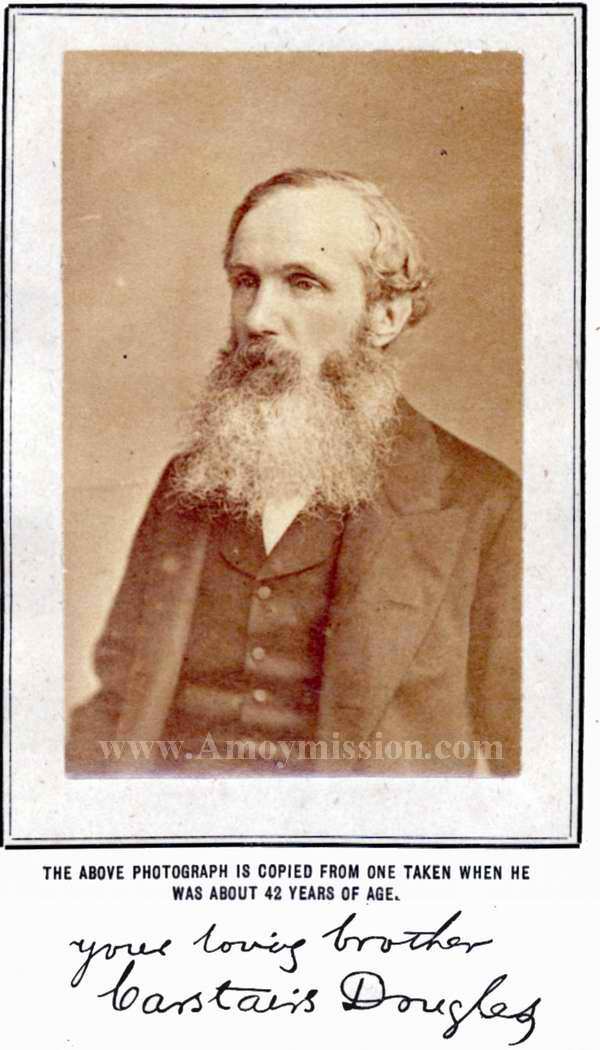
Carstairs Douglas has roots!


Carstairs Douglas, an early member of the Amoy Mission, was a fascinating character, and I have uploaded ten pages of info about him on www.Amoymagic.com. But it appears he was not the only high achiever in his family, based on a couple of recent e-mails from a lady in the U.K., who has said she would be happy to help anyone researching the Douglas family. Below are her e-mails.
Enjoy Amoy!
Dr. Bill
Carstairs Douglas Pages

September 14, 2008
I stumbled upon your website whilst researching my husband's family tree. Thankyou so much for posting all the information about Carstairs Douglas. It was a genealogists dream!
Carstairs was my husband's great great uncle; his whole family contained many men of the church. One of Carstairs' older brothers was george Cunninghame Monteath Douglas who was a hebraist and Reverend Principal of the Free Church Glasgow and his father was the Reverend at Kilbarchan, Scotland.
Thanks again,
Jean

September 16, 2008
Ref email 15/9/08, no I am not the Jean who contacted in 2003; I hadn't started the research into my husband's tree then. We don't have any more info on Carstairs Douglas, just what we have from you. However, if you go to St Brycedale's Church, Kirkcaldy website, you will see a photo of a stained glass window that is purported to be of him.
I have a large and comprehensive tree about his family though, and have essentially traced his mother's side of the family all the way back to the 17th century, with a fairly definite link to the Earls of Glencairn. His grandmother Ann Cunningham was an heiress who married the Rev John Monteath of Houston, Scotland. On the Douglas side, his.father the Reverend Robert Douglas of Kilbarchan, Renfrewshire, was directly descended from the Lairds of Barloch near Glasgow. These family members were steeped in the transformation that led to the Scottish Free Church. Furthermore, I have almost postively traced these Barloch Douglases to the Earls of Dalkeith.
In other words, Carstairs was born into a family which had some pretty impressive family roots in terms of the various doings of history. His own siblings, educated as he was at the Manse in Kilbarchan by his parents, all were high achievers. The eldest, Dr James Douglas, then John Monteath Douglas 'the Witty Laird of Barloch' parliamentary Whig candidate and author of works on Bimetallism, Robert Douglas (my husband' great grandfather) engineer and founder of Douglas and Grant Engineering, Kirkcaldy (one of his steam driven rice milling machines is still in use up the Irowaddy Delta in Burma!), George Cunningham Monteath Douglas, Reverend Principal of the Scottish Free Church College Glasgow (went to university at the age of 11; photo available from the National Portrait Gallery) and finally, Campbell Douglas the architect ( Carnegie Libray Ayr, amongst other things.)
I would be happy to supply information to anyone who might be researching the family.
Sincerely, Jean

Sunday, September 14, 2008

No American Devils...Japanese, maybe.


When in remote areas Chinese sometimes accost me and demand, "Who are you?"
I answer, "I'm an American devil." Almost (but not always!) this disarms them, and they laugh, and protest, "No! No! American friends, not devils!" But very many add, after a thoughtful pause, "Japanese devils, though."

Many of my elderly Chinese neighbors still remember the horrific experiences of the Japanese occupation of Amoy in 1938 and afterwards, but Fujian's encounters with the Japanese go back much further. In remote areas of Zhangzhou province, Lindun town for example, I've found the ruins of city walls built almost 400 years ago to protect villagers from the "pygmy bandits" (their derogatory term for Japanese invaders--still used in a plaque today in Quanzhou's Maritime Museum!). Oddly, another wall ran down the middle of Lindun town because the town had two factions that feuded each other--except when the Japanese came, at which point they united to fight off the pygmy bandits.

100 years ago the Japanese were taking Manchuria, Taiwan and other parts of China, and at the same time working overtime with the propaganda to convince Western nations that they had only peacable intents. We'd have probably not been taken by surprise at Pearl Harbor if we had paid attention to people like Millard, who way back in 1916 warned the U.S. and Europe that the Japanese had infiltrated Western peace organizations to encourage pacifism. It's sobering. Even today, I think we should seek peace, not war, but I suspect even now some of those crying "Peace!" really mean "Piece!" (as in, "I want a piece of Georgia, or Kosovo, or....).

This photo is from Millard, 1916 (p. 205) the caption says it all.

Fortunately, China's youth today seem to have forgiven Japan. They love frequenting Japanese restaurants, listening to Japanese pop stars, watching Japanese movies. And families like the Sabayashis from Japan have lived for years in China, teaching Japanese language and culture, and helping bridge the gaps of fear and mistrust. Hopefully, one of these days Japanese devils will go the way of American devils.

Enjoy Amoy!

Dr. Bill Xiamen University
www.amoymagic.com

Saturday, September 13, 2008

Ancient Chinese IRS

As I work on the book "Old Amoy in Foreigners' Eyes", using old texts and photos from my home library (Click here for a partial list), I come across some fascinating insights. This passage from one of MacGowan's books was about the ancient system of taxes, which was not overly oppressive, and the tactics of tax collectors--which were oppressive indeed. Read on to learn about the ANCIENT CHINESE INFERNAL REVENUE SERVICE!
Bill Brown Magic Xiamen--Guide to Xiamen and Fujian

Reverend John MacGowan, Lights and Shadows of Chinese Life, North China Daily News and Herald Limited, Shanghai 1909

FEW TAXES p. 3
With the exception of the dues collected at the various custom houses throughout the country, the only direct tax imposed by the Imperial Government is the land tax. Taxes for education, for the army and navy, for the defence of the Empire, as well as rates for the police, the poor, etc., are absolutely unknown. The civil list in China is a very model of simplicity, and gives the executive very little anxiety, for there are automatic systems that have been in existence from the earliest times that provide for the salaries and expenses of public servants in a manner highly satisfactory to everyone, excepting to the long-suffering masses from whom the money is extracted.

LAND TAX
The land tax… is a fixed one and was settled in A.D. 1644, when the present dynasty came into power. The land registers were then revised, and the amount that every man’s farm or holding had to pay was fixed by the imperial authorities. This seems to have been done in a very fair and generous spirit. The Government which affects to be a paternal one showed in this case, at least, great anxiety that this tax should not be an oppressive one….

As lands vary greatly in fertility, there was no uniformity in the levying of these taxes…in all cases due care has been taken that the farmers shall not be unduly distressed.

The Ancient Chinese IRS
Now whilst the land tax is in itself a very moderate one, the method of its collection renders it very oppressive, and certainly at all times it is more or less a source of trouble and vexation. The Government has entrusted the collection of it to a body of men that are notoriously of ill-repute, and who fro the very nature of the case must be dishonest. Not only have they no salaries, but they have actually to purchase their positions. The only privilege they demand in return for this outlay of their money is a free hand to get as much out of the people, by guile, by ruse, or by cunning, as they can; only they must be careful that everything they do must have an appearance of legality. Law, and ancient custom, and hoary traditions are sacred in the eyes of the Chinese, but there are a thousand-and-one ways by which these may be evaded, while the semblance of respect for them is still maintained.

A free-handed system like this exactly suits the genius of the Chinese, who prefer oblique methods to direct ones. It opens out a boundless field, where money can be gained more easily than by settled salaries….

Children of China (1937)


This delightful little volume by Stella M. Rudy was published in 1937 by Rand McNally, and is one of my favorites. The left pages are text, and the right pages are full-sized accompanying photos.

Below is a bit of the text, and some of the 30+ photos.

View more texts and photos on the Amoy Mission Project or Amoymagic.com

Enjoy Amoy!

Dr. Bill

Children of China

The fertile land of China-sometimes called the Flowery Kingdom-
is the home of one of the oldest nations in the world.

For centuries the Chinese people lived in peace, protected on the east by the ocean; on the south and southwest by high mountains and on the west by still higher mountams, great deserts. and high wide plains. Only the northern side was open to the attack of wild tribes, and there the Chmese built their Great Wall.

The Yangtze River which flows across central China is one of the great rivers of the world. The Yellow River in the north, and the West River in the south, are also important. The Grand Canal connects Hangchow and Tientjin. Three of China's greatest cities Shanghai, Canton, and Nankmg-are river ports. Beiping. an inland city, is the gateway for trade with northern Asia.

In northern China the winter are cold and the summers are hot; in southern China the climate is moist and warm.

Long, long ago there was a great and powerful gIant, called Chung Kuo, who knew how to do a great many wonderful things. But he made the mistake of thinking that he knew everything there was to learn, and he was not willing to share his ecrets with others. He shut himself in his house, locked the door, and went to sleep. Chung Ktuo~ means China, or the Middle Kingdom.

At last the great sleeping giant, Chung Kwo, began to stir. He unlocked his doors and looked around. Then he made a discovery. There were other countrie and other people as wise as he!

And when people of other countries peeped into this mysterious land they made discoveries. too. They found that long before the kings of other countries knew anything about silk the Chinese people were wearing gorgeous silk robes. They discovered that the Chinese people were eating out of beautiful porcelain dishes when people of other lands were using dishes of coarse clay. They learned that long before the days of Abraham, Isaac, and Jacob, there were great cities and towns in China, the Middle Kingdom.


A GLIMPSE INTO CHINA

When one friend meets another in China, he bows and shakes his own hand instead of his friend's. Chinese family names come first instead of last. To read a book, the Chinese begin at the back and read from right to left, and from top to bottom.

Chinese people wear fur on the inside of their coats instead of on the outside. Mourners wear white instead of black, and brides wear red instead of white. The bride goes to the home of the groom for the wedding instead of being married at her home. The Chinese push their needles away from them instead of toward them when they sew, and do the same with a knife when peeling fruit or vegetables.

In China, fruit is eaten at the beginning of the meal and soup near the end. Chinese people do not think it impolite to make a noise when eating soup or sipping tea.

It would seem to us like a topsy-turvy land, but to the Chinese it is our ways that are strange.

WRITING PROM RIGHT TO LEPT
There are more people in China than in any other country -- one-fourth of all the people in the world. They live in big walled cities with narrow streets, in villages far back in the mountains, along rIvers. on boats, and in caves. The Chinese have yellow kin, straight black hair, and bright black. almond-haped eyes. The people of the south are smaller than those of the north. There are so many different languages spoken in China that it is difficult for people from different parts of the country to understand one another. The people of northern and central China speak the Mandarin language, the official language of China. Those of the south speak Cantonese. a gay and musical language.

The Chinese people are wise, patient, and industrious. They have gIven the world many things--paper, tea, silk, lacquer ware, fine porcelain. umbrellas, carved jade, fine needlework, gunpowder, and the compass. They wore silk gowns, carried umbrellas, shot off firecrackers, and printed books hundreds of years before Columbus discovered America.

Monday, September 8, 2008

Jessie M. Johnston


Jessie Johnston was a young single missionary in Amoy for 18 years, and immediately after her death her family published a book about her life and work. Click Here to read the entire text of "Jin Ko-Niu--A Brief Sketch of the Life of Jessie M. Johnston For Eighteen Years W.M.A. Missionary in Amoy, China" (the title is almost longer than the book!), by her sisters Meta and Lena with a preface by her mother. (published by T. French Downie, London, 1907).

It's an interesting tale (though the Victorian language gets to me a bit), but I prize the little book because of the photos, which I've scanned and will upload as I get time. My favorite is entitled, "Sixty-five pupils in Amoy School who all became teachers." Missionary schools in Amoy (now Xiamen) played a very important role in the development of modern Chinese education--particularly education for women. Read more about Amoy's Pioneer Educators in "Discover Gulangyu's".

Speaking of pioneering education--our Xiamen University MBA Center gave out China's first MBA Degrees! (we beat Nankai University by 6 days; when I arrived in 1988, MBA was not popular, to say the least--creeping capitalist thinking and all that; now its the hottest subject in China).
Enjoy Amoy!

Friday, September 5, 2008

Peter and Connie Anderson -- Fuzhou and Amoy


Peter Anderson, a missionary in Amoy (on Gulangyu, or Kulongsoo), married Constance of the English Presbyterian Mission, in Fiuzhou (Foochow). They were married in the beautiful old stone church on Nantai island--my favorite church in Fujian (right out of Celtic legend).

The Andersons had a big part in the Amoy Mission's relief work for refugees on Gulangyu Islet in 1938 and 1939, as I learned from their son, John Anderson, who was born in Hope Hospital. John only spent 18 months in Amoy, but in October 2008 he and his wife will return to Xiamen for a month to trace their Fujian roots, and find some of the old places his mother wrote about.

Sue and I met John and Jennifer (his wife) in their home in Mountain View, California, and they were kind enough to allow me to scan many of their photos, which I will upload as I have time. Please note that all of these photos belong to the Andersons; anyone using them without permission will be shot (with slow bullets). Seriously.... please contact me if you'd like any of the texts or photos, and I'll pass the word on to the Anderson.,

Enjoy Amoy! Dr. Bill

Old China in Foreigners' Eyes (photos and text)


I have hundreds of old books on China, and thousands of old photos, which I hope to upload. The photos are fascinating, the articles and books are insightful (often humorous as well).
Check our website, www.amoymagic.com for more info and photos about the Amoy Mission.

Enjoy Amoy!

Dr. Bill