Wednesday, February 11, 2015

Charles Jung Kear of Amoy (update)

 For those who read the previous post on Charles Jung Kear of Amoy, here is another letter from the descendant seeking to learn more about him. Any info would be greatly appreciated!
Bill Brown

 Bill, it was so good to received you email.  Many thanks.

As we are going away for a few days, i actually posted the information to you and the address I mailed it to :  Mr Bill Brown, Box 1288, Xiamen University, Xiamen Fujian China 361005.  So fingers crossed that you will receive the A4 size padded bag when you get back from your trip. I mailed postcards to my family from Xiamen and happy to report all arrived approximately 3/4 weeks later.

It was difficult to decide what I should send.  I went through numerous paperwork and found anything that I thought would/may help the Chinese end.  Im not sure how many  old Churches still stand in Xiamen but we did think that would be a start (hence why we were outside the old Presbyterian Church). Luck was with us that day.  The other strong clue was my gran telling my mother that her father could speak "Scotch and Chinese".  Did Charles attend a Missionary school?  Obviously he was well educated for someone of that period as he worked for a time as a court interpreter acting for the Chinese Miners one would assume in the Hill End/Bathurst region was full of Chinese mining for gold. He may have been a full blood Chinese and adopted the name "Kear" on arrival in Australia.  Or his father could have been Scottish, a missionary or a naval man.  We are betting on the missionary part although cousin Helen has done research on line and have not found any Kears coming to Amoy. Old residents in Mudgee insisted that Charles was a "full blood"  and we were told that he and his sons dressed in traditional clothing and had pigtails. And given the strong chinese features of my gran Hannah Vashti and other relatives, it seems that could be so.

All of Charles's children had biblical names. (see letter from David Kear, NZ - check out on Google his background)

However,  the Kears come from the Forest of Dean in the UK, and have resided there for hundreds of years - all well documented.  It seems puzzling that Charles's wife Jean Shergold (Shurgold) came from Wilshire, very close to the Forest of Dean.  David Kear in New Zealand has made a lifetime search of the Kears and has made a comprehensive and organised file of the family.  He generously has shared it with us.  You will see his notes to me, so logical and organised.  David is now 92 and it appears no longer is using a computer when he wrote to me late last year.  His son in Melbourne is now taking up the Kear research.  I have yet to contact him.

Whist in Xiamen, we stayed at the Swiss International Hotel opposite the Island and actually walked past the University.  So close.

Obviously Kear/Chinese research has been picked up by us all and put aside given personal circumstances and it was really when I retired some 9 years ago that I had a bit more time and though I should get a move on.  Both MK and HM my cousins have done the same whilst a lot younger .

So fingers crossed that there are some researchers who may help us further.

We are happy to reimburse copying costs/postage where/as needed.

Longing for more news.

Many, many thanks
J. 
Dr. Bill's Amazon eBooks

"Fujian Adventure"


Xiamen University www.amoymagic.com

Seeking Charles Jung Kear of Amoy (19th Century)


Below is the latest letter from an Australian lady searching for info on her great grandfather, Charles Jung Kear, born in Amoy. If you have any info, please let me know and I can have her contact you!

Jan. 9, 2015
Dear Bill,
I have just finished photocopying a lot of material that you might find fun to read on my long search for information  on my great grandfather, Charles Jung Kear born in Amoy.  If nothing else, if you enjoy reading puzzles, it will give you something to think about. Would you please send me your mailing address so I can post?

This last trip to China seemed to be difficult.  Perhaps because I am now 74 and was traveling with energetic daughter J and partner S. Oh, and fit husband M.!  We did a huge amount of walking.  We flew into Shanghai where we have been a few times and always enjoy, then 8 hrs rail to Xiamen, followed by a flight to HK and home.  I now wish we had spent a week in Xiamen, particularly after the amazing luck of bumping into A.F. outside the Presbyterian Church.  How lucky was that and that she spoke English!  We had been to the Museum and no one could speak English and we had just about given up on the whole idea. I was very despondent. And for A. to tell me that she knew you.  I had read all of your blogs and emailed you previously but assumed you were very busy.  (I worked at M. University for some 30 odd years on and off).  What a pity we could not have met.

I was overwhelmed when we got to Xiamen.  I had read about the village of 600,000 people but found a high rise city of perhaps 3 million? I wanted a village with colonial houses and streets that I could meander around. Yes, I know.  Dreaming. 

We first visited China in 1983 - Beijing and have been back perhaps 25 times and to different regions.  Even as a kid I was fascinated with everything oriental without knowing anything about my grandmother's parents.  Whilst gran lived with us for some years, she never ever spoke of her parents and my mother told me that gran had burnt her birth certificate at some stage.  Being Chinese was not highly thought of in Australia in those days. My own search such as it was, was when I was about 18 years old and I went to visit Mudgee, NSW (west of Sydney) where my great grandparents lived to search records.  In those days it was all manual and not well kept.

It has been only over the last few years when I put an add in the Sydney Morning Herald looking for family connections that I met HM and M Kear - both younger than me - 2nd cousins, who have also been researching.  So now we are in touch and every now and again, try researching another angle.

The puzzle is only Xiamen that we cannot "crack".

It would be wonderful if we could find some relatives/information/whatever.  I would be back to Xiamen in a flash!

Cheers and many thanks

Sincerely
JC, Australia

Dr. Bill's Amazon eBooks
www.amoymagic.com

Bill Brown Xiamen University www.amoymagic.com

Tuesday, November 25, 2014

John MacGowan of Amoy -- and Hayley Mills?!

Ahoy from Amoy!

I was happy to hear again from the descendants of John MacGowan, the Amoy missionary who wrote so many books a century ago, (I have all of them). But there is almost nothing about his own life, and I have only a couple photos of him, so it is fun to learn a bit more about him--and a surprise to learn that one of his descendants is Hayley Mills (I had a crush on her when I was too young to even know what a crush was!). I was also surprised to learn that Hayley's ancestors had been in Siam in the 1830s (she was in the musical "Anna and the King of Siam").

Below is the second email (which I take the liberty of posting, since it does not have their names).

Enjoy Amoy!

Dr. Bill's Amazon eBooks
www.amoymagic.com
Yesterday's Email:
John MacGowan's descendent is Hayley Mills, the actress.  In 1990's she toured in the musical "The King & I" based on the book "Anna and the King of Siam."   I wondered if she knew that her family had been in Siam in the 1830's: decades before Anna got there.  Hayley Mills' family might have info about MacGowan.  We have a little info about the time he married Jennie Peet. I'm not at home now so I can't give you all the names but I'll fill it in when I get back in about 2 weeks.  
 
Lyman Burt Peet married _____ Sherrill (first wife who died in China) 
Their daughter Jennie Peet (born in Siam) married John MacGowan
Their daughter ______married____ Bell
Their daughter Mary Hayley Bell married John Mills.
Their daughter is Hayley Mills.
 
Do MaGowan's books have photos?
 
 We are descended from Peet's second wife Hannah Louisa Plimpton.  She later married Rev. Charles Hartwell.
We have photos of chapels and lists of villages Rev Peet served as well as and drawings and banners.  Would you like me to email you copies?  We have shoes for bound feet, etc...

Bill Brown Xiamen University www.amoymagic.com

Sunday, November 23, 2014

Lyman Burton Peet and John Macgowan, Amoy and Foochow

Today I received the intriguing but unsigned email below (at the bottom of this post). I hope to hear more from them. It has been so hard obtaining information, photos, etc. for the proposed Amoy Mission museum we hope to open.

Dr. Bill
Bill's Amazon eBooks
www.amoymagic.com
Unsigned Email Received Today
 My family was in Amoy / Pagoda Anchorage from 1847 till 1925. Three generations. Lyman Burt Peet and family went to China from Siam. His son Lyman Plimpton Peet became a missionary. His daughter Jennie married British missionary Rev Macgowan. His daughter Ellen Louisa married Rev George Henry Hubbard. Nellie was born there and died there in 1925. Her children were born in Foochow. My grandmother was her youngest. We have some photos and drawings.

Wednesday, April 2, 2014

Fujian Adventure eBook $1.99 promotion on Amazon! 魅力福建


http://www.amazon.com/gp/product/B00J22FA98/ref=as_li_ss_tl?ie=UTF8&camp=1789&creative=390957&creativeASIN=B00J22FA98&linkCode=as2&tag=amoymagic-20
http://www.amazon.com/gp/product/B00J22FA98/ref=as_li_ss_tl?ie=UTF8&camp=1789&creative=390957&creativeASIN=B00J22FA98&linkCode=as2&tag=amoymagic-20With over 520 pages and almost 700 photos, many by Fujian's top photographers, Fujian Adventure is now an eBook on Amazon for $1.99 promotional price ($5.99 regularly). Click here to download  a copy and if you enjoy it, please rate it and share the link with your friends!

If you (like me), don't have a Kindle, download  Free Amazon Reading Apps to read it on Android and Apple devices,or Mac and Windows computers.
Thanks so much for helping to get the word out. I hope to have some of my other 11 books online this summer. 
Enjoy Amoy! 

Dr. Bill 

Amazon description of Fujian Adventure.
Columbus' goal was not a New World but a shortcut to India and to Marco Polo’s fabled Zayton in Fujian, China. Columbus never made it to Zayton, but you can.

Over 500 pages and almost 700 photos, many by award-winning Chinese photographers, bring to life the people and places of Fujian (Fukien), the cradle of Chinese seafaring (200 B.C.), start of the Maritime Silk Route, port of departure for Marco Polo and ibn Battuta, and ancestral home of most overseas Chinese.
Meet Admiral Zhenghe, the "real" Sinbad; the ancient Southern Shaolin Kung Fu Temple’s youthful abbot; the Hui'an maidens who cover their heads, bare their bellies, and only sleep with their husbands 3 nights a year; the firewalkers who dance across the flames bearing heavy idols; melancholy Miss Mo who became the sea goddess Mazu; Zayton’s famous marionette makers; the Anxi farmers who produced the tea tossed overboard during the Boston Tea Party. Visit China’s first Protestant church and the planet’s last Manichean temple. Explore Gulangyu, the Roaring 20s’ “richest square mile on earth,” which even today has over 1,000 “Amoy Deco” mansions. Discover the secret of Hakka roundhouses that Nixon and the CIA thought were missile silos, and then visit the nearby Amoy tiger preserve. Enjoy scenic Sanming, with China's 4th largest gem beds, China’s largest sleeping Buddha, Ming Dynasty villages, enchanting caverns and underground lakes. Marvel at Wuyi Mountain’s 2,000-year-old Min Palace, and the Eden-like biological diversity that drew French naturalists in the 1700s to study the rare plants, king cobras and 33 foot pythons.

And of course there’s the Fujian food. Moliere said "Man should eat to live, not eat to live," but Dr. Bill says, "Moliere never ate Chinese food—especially Fujian food.”

Locals say Fujian is “8 parts mountain, 1 part water, 1 part field”. This torturous terrain not only gave rise to an innovative and tough people but also to more local dialects and greater cultural diversity—including cuisines—than any other province. Every hill, valley and river has a story behind it, and Dr. Bill invites you to explore them.

Author Bill Brown, Prof. of Organizational Behavior and Business Strategy at School of Management, Xiamen University, was Fujian's first foreign permanent resident and has driven over 200,000 km. around China,even through the Gobi Desert and Tibet,幸福福建),but still considers Fujian the most fascinating province for foreigners. In addition to textbooks such as Art of Business Warfare (Beijing University Press), he has written ten books about Fujian. He has also written and hosted several TV documentaries, including a 62-episode mini-series, "Fujian in a Foreigner's Eyes". In addition to teaching MBA, he hosts the weekly "Xingfu Fujian"《幸福福建》。
潘维廉/潘威廉,厦门大学管理学院福建省
 Bill Brown
Xiamen University
www.amoymagic.com

Thursday, January 9, 2014

Researching Nicholas Fitzmaurice British Consul General, Kulangsu / Gulangyu 1937 - 1941

Below is a fascinating email received today from Ms. Mary T. If anyone has info on Nicholas Fitzmaurice, plesae share it (it would be fun to see the old photos she alludes to).

Dear Mr. Brown,
Kolongsu
 
I plan to visit Gulangyu in March this year with my daughter.    The Consulate General Residence was my first home.   I was born in Peking in 1937, Nicholas Fitzmaurice’s daughter.   My husband and I toured China in 1994 and finished our travels on Gulangyu where, with the help of the Museum Curator and a charming girl with some English from a small hotel, we eventually located the sad-looking house – almost unrecognisable from the childhood photographs I had taken with me.   It was smothered with 50+ years of sub-tropical jungle, very decrepit with crumbling walls and ceilings and damaged light fittings etc.   I was just thrilled it was still there and had survived the Japanese, who interred my father with  Murray MacLehose, his ‘No. 2” at the time and who, in the 1970’s, was one of Hong Kong’s most successful Governors. Also I wondered if Mao’s  Red Guards had sacked it.   
 
My husband took masses of photographs of the place and when home I sent copies of 1941 and 1994 to the curator and Hua Chung Wha (?sp) as  a thank-you for their help.   I didn’t expect any response from them, so imagine my delight and surprise when I opened my daily copy of The Times to see a photograph of the Consulate!   It was being “opened” after restoration by the Chinese Government and looked almost identical to the photographs I had sent.   It was a huge thrill for me and now an opportunity has arisen which will enable me to return there.   P & O have a cruise from Sydney to Hong Kong  in February and amongst other ports they are stopping for a day in Xiamen with an excursion to Gulangyu.     My daughter lives in Australia and she is also very excited about the memories she has heard being brought to life.   I have a feeling that in the last 20 years, Gulangyu is very much more developed than when I was last there, but so is everywhere else!
 
My father knew the Japanese were going to invade Kulangsu as they were firing on the beaches and as it was almost impossible to get passage to Britain then, we were evacuated to Dunedin where some of my father’s cousins lived.   It was not until 1943 he joined us there and we returned to England via the Panama Canal and across the Atlantic without a convoy!   Great excitement for my brother and me, living in life-jackets and lifeboat drill every day.  
 
Are you able to advise me what the Consulate is now being used for?  I found a website which said that it is a coin museum but has not been updated since 2007 and I wonder whether that is still the case.   I am not clever enough to identify it on any map.   I should be grateful if you would have time to help me with this.   I leave for Australia on ...
 
Best wishes,
Mary Txxxx (nee Fitzmaurice)
 
Fun Anecdote about the Consulate: it was built on a bluff atop Zhangzhou Road in Tianwei--the best fengshui on the islet. Chinese were furious but could do nothing. It was originally two floors, but after a typhoon blew off the upper floor, the British declined to rebuilt it, and it is one story to this day. The Chinese took the typhoon as evidence of God's judgement on the invaders, and chuckle about it to this day.

Bill Brown
Xiamen University
www.amoymagic.com

Monday, October 21, 2013

Huang Rongyuan Mansion Gulangyu 32 Fujian Rd

Huang Rongyuan Mansion 黄荣远堂 Gulangyu Kulongsoo Kulangsu Amoy Fukien
Many Chinese & foreigners query about ancestors in old Amoy (former name of Xiamen). Today, a lady from WLRN Public Radio & Television, Miami, Florida, inquired about the house at #32 Fujian Rd. (she actually wrote #3 Lujiao Rd., but the photo was of Huang Rongyuan Mansion at #32 Fujian Rd). Since others have also inquired about this estate, which is right beside the Spanish Gothic Catholic Church and former Japanese consulate, police station and jail, I am posting my reply online. This description is from my book Discover Gulangyu!    魅力鼓浪屿, Xiamen University Press (I have 10 books now on Xiamen and Fujian Province, and hope to get them converted soon to e-Book format).  Enjoy Amoy!  Dr. Bill


#32 Fujian Rd   Huang Rongyuan Mansion (黄荣远堂), circa 1920, is  directly opposite Sea and Sky Palace.  The villa reminds me of antebellum mansions in the Deep South—though no Southerner ever had a garden like this, with its towering palms, shimmering pool, and Chinese pavilion and rockery to the left, from which you can snap a photo of the Spanish Gothic Catholic Church on the other side of the wall.
Huang Rongyuan Villa Rockery Gulangyu Kulongsoo Amoy

Huang Rongyuan Villa was designed by a Filipino architect and built in 1920 by Shi Guangchong, a Philippine overseas Chinese whose ancestral home was Jinjiang, and who was related to one of Gulangyu’s most famous residents. His nephew’s wife was the first daughter of Lin Erjia (林尔嘉), creator of Shuzhuang Garden (菽庄花园).

While Gulangyu was a heavenly place to visit, by the 1930s the Japanese were making it a hell of a place to live in, and in 1937 Mr. Shi hightailed it back to the relatively safety of the Philippines.  The villa was taken over by Mr. Huang Zhongxun, who then gave it to his younger brother, Huang Zhongping.  He renamed the place Huang Rongyuan Villa, after the real estate company founded by Huang Wenhua (a Nan’an native who made a fortune in developing wilderness in Vietnam), and his son (the same fellow who walled in Sunlight Rock and made it his private garden; read more in the Yongchun Rd. chapter).
Huang Rongyuan Villa Gulangyu Kolongsu Kolongsoo Amoy Fukien

Huang Rongyuan Villa is pretty much a Western-style dwelling, with its “Southern mansion” two-story curved front porch and Ionic columns.  But few Western homes boast as many styles of windows on one front, and the upper floor, with its dozen or more columns, looks like it was added as an afterthought.  Still, I appreciate the imagination that went into its design and construction, and find it astonishing that such a magnificent building was later used as the Deer Reef Kindergarten.
The Spanish Catholic Church (#34 Lujiao Rd.) is on the other side of the garden wall, just across from the former Japanese consulate.

福建路32号:黄荣远堂 大约建于1920年,就在海天堂构的正对面。这座别墅让我想起美国南北战争前南方的住宅——尽管那些南方人都没有这样的花园,园子里是参天的棕榈树,波光粼粼的池面,左边是中式的亭子和假山,在假山上还能抓拍到围墙另一侧的西班牙哥特式天主教堂。
Gulangyu Catholic Church Amoy Fukien
Gulangyu Catholic Church

黄荣远堂由菲律宾建筑师设计,菲律宾华侨施光从于1920年建造,施祖籍晋江,他和鼓浪屿的名人菽庄花园的主人林尔嘉还有一些渊源(林的长女为施的侄媳)。

鼓浪屿曾经是个天堂般的旅游胜地,但是在上世纪30年代日本人却把这里变成了人间地狱。1937年,施先生匆忙逃离了鼓浪屿回到相对安全的菲律宾。这座别墅转入黄仲训名下,后来又转给其弟黄仲评。黄仲评将别墅改名为“黄荣远堂”,黄荣远堂是黄文华(南安人,在越南开发荒地致富)和其子(就是那个将日光岩圈为私家花园的家伙,在永春路章节你可以知道更多)创办的房地产公司。
Inside Gulangyu Catholic Church

黄荣远堂是一幢以西洋风格为主的建筑,有“南方大宅”的两层拱券和爱奥尼克式的柱子,但很少西式房子在前壁会有这么多各式各样的窗棂,二楼有十几根廊柱,看上去像是后来才添加上去的。不过我仍然颇为欣赏这座房子富有想像力的设计和结构,让我颇为惊讶的是,这座壮观的楼房后来成了鹿礁幼儿园。

西班牙天主教堂(鹿礁路34号)就位于黄荣远堂院子围墙的另一侧,在日本领事馆的正对面。

Bill Brown
  Xiamen University

www.amoymagic.com

Sunday, March 24, 2013

Southern Shaolin Temple Fujian

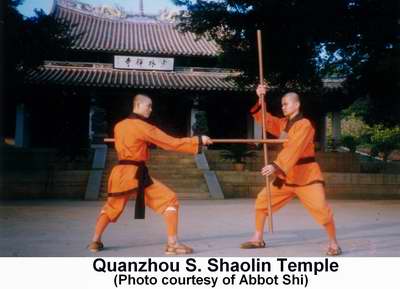
I receive many emails from people inquiring about the Southern Shaolin Kung FuTemple in Fujian.  There are two--one in Quanzhou and one in Putian, and both claim to be the origin of Southern Shaolin Kung Fu, though neither can prove it.

Southern Shaolin Kung Fu Temple Quanzhou Zayton Fujian Fukien AmoyBelow is an inquiry from a man, David M., in Singapore.  If you have helpful information, please post it or email me and I'll pass it on.  Enjoy Amoy!  Dr. Bill

Dear Bill,

Greetings from Singapore. I'm currently researching the life of my kung fu teacher's master, Chee Kim Thong (徐金棟; 1918-2001) and was wondering whether your knowledge of Xiamen would cast light on a murky period in the master's life.

Master Chee was born in Putian. As a young man he joined a guerrilla faction called the Big Knife Army. In this period - the late 1930s - he learned a soft Shaolin art called Luohan Ruyiquan from a Buddhist: a former abbot who lived in seclusion in a cave by a temple. I have heard this temple called Lam Phor Thor, and the abbot named variously as Yit Sim and Yik Cha'an Sze. I am unsure whether the correct temple is in Xiamen or Putian. The place names, and the name of the abbot, are phonetic transcriptions of Hokkien and do not appear to correspond with any information I can find online, and alas I'm unsure how the Hokkien pronunciations might correspond to Mandarin. I lack Chinese characters for these names.

If any of the names I mention suggest anything to you, I would be very grateful for your thoughts. But if not, or if you don't have time for this query at present, don't worry. I'll continue investigating the matter any way I can.

Best wishes,

Chris M.

Southern Shaolin Temple Quanzhou Fujian Fukien
Unfortunately the facts of Master Chee's life are already difficult to tease out; my efforts are plagued by a mixture of legend and distortion, and a sheer lack of the pertinent information among his close students. Frankly I don't know how to clarify some of the questions I have about Master Chee's early life, and no-one outside of Master's Chee's circle appears even to have heard of Luohan Ruyiquan.

Bill Brown Xiamen University www.amoymagic.com

Monday, February 18, 2013

Trinity Church Choir Gulangyu July 10 1949

I received from Xiamen government this morning the proposal for a new museum on Gulangyu, which will display old photos, documents, etc.--and at the same time I received from Mr. Ken Lin, in New York, a photo of Gulangyu's Trinity Church Choir, taken July 10, 1949.  Great timing!

Trinity church was considered at one time China's most beautiful Protestant Church, and was named Trinity not just because of the "Holy Trinity" but also because three denominations cooperated in building it.  

Mr. Ken Lin wrote, "My relative Dr. Yu Tang Lin held wedding in Union Church [XM Govt. spent over 2 million rebuilding this in 2010]  that you mentioned below before leaving China. His elder sister was my Mom's godmother and used to live on the 3rd floor of my house in Kulangsu."


Trinity Church Choir, Gulangyu Amoy July 10, 1949 kulongsu

Xiamen, by the way, now has over 40 registered churches.  Click Here for info about them, or Click Here for info about Fujian Churches and Christian activities.

Miss Chen, of Xiamen's Jehovah Nissi Christian Bookstore, will soon publish a book about Xiamen church history.

Bill Brown Xiamen University www.amoymagic.com

Monday, September 10, 2012

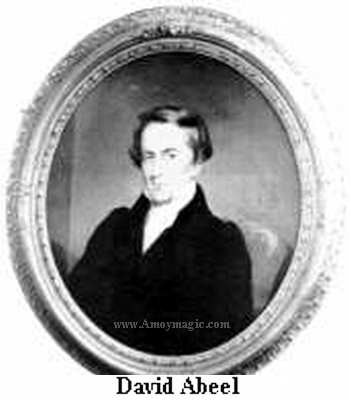
David Abeel-- Medical Missionary in Amoy?

David Abeel Founder of Amoy Mission
 A Prof. in Zhejiang has posed an interesting question.  Did David Abeel, father of the Amoy Mission, personally engaged in medical work.  I post my reply on the blog, in the hopes that someone more knowledgeable than I will have more insights.

The answer, I think, should be yes--though we cannot infer this directly, as far as I can tell, from David Abeel's memoirs.  But given Abeel's two years of medical training, and his appreciation of medical work, it is likely that not only was the Amoy medical work the first in China, but Abeel assisted in Amoy's medical work.  Consider the passage below, in which the medical work was said to have been undertaken by Cumming, Hepburn and Abeel.  (Source: "The Missionary Review of the World," Vol. V., January to December, 1892, p. 215 (Pierson, Arthur T., Editor-in-, Chief, Funk & Wagnalls, NY).

"Medical Work--When our mission was first founded the medical department was the strongest factor for a short time.  In 1843 there were two regularly certified physicians--Drs. Cumming and J.C. Hepburn--connected with the mission, and Dr. Abeel had studied medicine for the greater part of two years.  Dr. Abeel left Amoy in 1844, Dr. Hepburn in 1845, Dr. Cumming in 1847.  This work was not taken up again until Dr. T. May Kiog, an educated Chinese lady-physician, came to Amoy in 1889, and Dr. J.A. Otte, a few months after in January, 1888."

The Ricci Institute's brief biography of Abeel notes that he "merged his medical studies with Christian ministry."  It is unlikely that Abeel did not use his medical talents in Amoy, given that he had "commented upon the desperate need for medical services by  the persons living in the Amoy area" (Hoff, Marvin D., "The Reformed Church in America: Structures for Mission, Issues 14-16. Wm. B. Eerdmans Publishing Co., MI, 1985, p. 39

Abeel's Memoirs may be silent on his involvement in the medical work simply because of a bias of many Western supporters of missions, who objected to "wasting" funds on any work but that of saving the soul--a bias against the "social gospel" that exists to this day.  Abeel alluded to this bias himself when he wrote of his moving experience at Dr. Parker's Canton medical clinic in 1838 (Abeel's Memoir, p. 178):

""If those who have questioned the propriety of medical practice among the heathen were to pass a day in this hospital, they would be impressed with the mercy of God in opening so wide a door of usefulness to this guarded empire." (Williamson, Rev. G.R., "Memoir of the Rev. David Abeel," D.D., Robert Carter, NY, 1848).

In summary, given Dr. Abeel's training, and his appreciation of medical work, it is unlikely that this resourceful mission pioneer did not use his medical skills to aid Doctors Cumming and Hepburn with their work in Amoy.  If anyone has other information on Abeel's medical work in Amoy, we'd be glad to hear of it!
 
Bill Brown               Xiamen University           
www.amoymagic.com

Tuesday, August 21, 2012

Philip Wilson Pitcher Brief Biography (Amoy Missionary)

Several have inquired about the life of Reverend Philip Wilson Pitcher, who was part of the Amoy Mission and wrote "Fifty Years in Amoy," (click for full text) and "In and About Amoy," (available at archive.org), two of my favorite old books on Amoy (now Xiamen).  Pitcher is my favorite Old Amoy Author, second only to John MacGowan, who wrote half a dozen books (all of which are chock full of delightful old China photographs).

Below is the only information I could find about Pitcher's life, taken from the 1916 edition of Officers of Rutgers College.

Philip Wilson Pitcher
 Born at Upper Red Hook, N.Y., Jan. 31, 1856, Clergyman, R. C.A. [Reformed Church of America--

formerly Dutch Reformed Mission] Missionary to China, Principal Boys' Academy, Author "Fifty Years in Amoy," etc. New Brunswick Seminary, 1883, A.M. (Rutgers, 1885). Died, July 21, 1915.
 

Source: Catalogue of the officers and alumni of Rutgers College (Originally Queen's College) in New Brunswick, N.J.,1766 to 1916
Compiled by Rev. John Howard Raven, 1891, Biographer of the Alumni Association, Trenton, N.J. State Gazette Publishing Company, Printers, 1916


Bill Brown  
Xiamen University  
 www.amoymagic.com

Thursday, March 29, 2012

Achuen Grace Amoy (Born Amoy 1846)

Prof. Mary Chapman is researching a Chinese lady, Achuen Grace Amoy, who was born in Amoy in 1846, raised in London, and later married Edward Eaton, a silk merchant. If you have relevant information, please contact Prof. Chapman (contact info at the end of this post).  The info below is Prof. Chapman's email query:
Enjoy Amoy!
 Bill Brown


"I am doing research on a Chinese woman who was raised in London, UK beginning in 1853, rescued from circus-entertainer owners by the Strangers' Home missionaries in 1855, and trained at the Home and Colonial School before returning to Amoy in the early 1860s on board the Jason (via Sydney, Australia). She intended to work as a missionary in Amoy (Xiamen), probably with a London Missionary group. She was Presbyterian. She had multiple names: Achuen Amoy, or Achuen Grace Amoy, or Achuen Grace Amoy Trefusis. Just wondering if any of these details are useful or if any information on your site might help me learn more about her missionary work in Amoy. She was born in 1846 and later married a silk merchant Edward Eaton. Thanks."
Mary Chapman


Dr. Mary Chapman
Associate Professor and M.A. Advisor
Department of English
University of British Columbia
#510-1873 East Mall
Vancouver, BC V6T 1Z1

E-mail: mary.chapman@ubc.ca
http://faculty.arts.ubc.ca/~mchapman

http://www.arts.ubc.ca/


Dr. Chapman is Co-editor with Angela Mills of *Treacherous Texts: US Suffrage Literature 1846-1946*

http://rutgerspress.rutgers.edu/acatalog/treacherous_texts.html

Winner of the 2011 Susan Koppelman Prize for Best Anthology in Feminist Popular Studies
Now available in paperback!


Bill Brown


 Xiamen University         www.amoymagic.com

Wednesday, August 17, 2011

Amoy Junk, Waard, 1922

Ahoy from Amoy!

I'm working on another historical book about Amoy, and have run into a dead end trying to find a copy of the Popular Mechanics December 1922 edition.  Does anyone have an idea where I can get it, other than the low quality scan at Google Books?  I'd love to get either the original page or a high resolution scan of page 823 (I do have the original photo from which the page was made, but need the sketches in it--a scan of the entire page).

The China Review, Volume 3, tells the story of how Waard prepared to cross the Pacific in his Amoy junk.  It turned out to be quite a challenge for him, his son, and his Chinese wife and crew. 

Fortunately he did have a Chinese wife, who knew the junk, and brought her through typhoons so severe that they lost the rudder not once but twice!  But Waard said that only an Amoy junk could have made the crossing.  The waters off Amoy (now Xiamen) have long been notorious for their dangerous currents--even though Amoy harbor itself has for at least 500 years been prized as a great port and safe haven.

Read the China Review article, the December 1922 Popular Mechanics article, and after that, read "The House with Red Sails," a novel by Leone Adelson based on the family's life upon the junk named Amoy (I like its dozen or so pencil sketches).

Click these images for larger views of the China Review article, and the illustration in Popular Mechanics.

Enjoy Amoy!
Dr. Bill
Bill Brown
Xiamen University
www.amoymagic.com

Monday, August 1, 2011

Xiamen University Music Concert 1920s

Xiamen's (Amoy's) tiny "Gulangyu Islet" (formerly Kulongsoo, Kolongsoo, etc.) is well known as the Isle of Music, with more pianos per capita (1 in 5 families have a piano) than anywhere else in China.  Eleanor Doty, wife of an American Amoy missionary Elihu Doty, had the first piano in the 1850s, according to the memoirs of Mary Doty, who was 6 at the time.  

The Amoy Mission built China's first Protestant Church (Xinjie Church), and many not only became Christians but also musicians--especially pianists, because of their use in worship.The small island of Xiamen has produced several hundred well known Chinese musicians, including Yin Chengzong, whom the New York Times said was the best Chinese pianist on the planet (and who was famous for saving pianos from destruction during the Cultural Revolution by rolling one out into Tiananmen Square and playing revolutionary music; who could destroy a politically correct instrument!).

In the 1920s, a British resident of Gulangyu attended a music concert at the newly built Xiamen University, (厦门大学,then known as Amoy University),which was built in 1921 by the Henry Ford of Asia, Tan Kah Kee (陈嘉庚,who invested over USD 100 million in education--over 1 billion in today's dollars).  She  wrote about this concert in her fascinating account of foreign life in Amoy, "A Race of Green Ginger." (I've never figured out what the title means).  Below is her delightful account of this concert.

 Amoy University Music Concert, 1920s
Anne-Averil Mackenzie, "A Race of Green Ginger":

'Let me ask the Lim Boon Kengs if we may bring you to the concert at the University. There are going to be celebrated musi­cians, playing the classical table lute.'

....'I do not like the Chinese,' she said stubbornly.

'You don't know them.'

....She really was impossible. I meant to go, but, all the hardness gone from her face, she was playing Debussy, which I could never resist, and ... How I wished that, like the Lims' daughter Ena, she could enjoy the music of both Europe and Asia. Ena, who told me of her love of the Chinese flute, 'especially when it is played at the dead of night'; Ena, then a quiet, but never anonymous girl in the shadow of her formidable mother, who was to win distinc­tion at the Royal Academy of Music in London, sing the classics of both East and West, write poetry in the style and manner of her forebears and, prevented by circumstances from living in Amoy, to campaign as competendy as her mother for the social services in Singapore, and to send her son to Cambridge.

Ena inherits the tradition of the integrated life and the zest for all aspects of it, which is so salient a characteristic of the educated Chinese. It struck us vividly then that this wholeness of life was still largely taken for granted; the universality of man held to be right and normal, not suspect and phenomenal as we of the West, who have lost it, regard versatility. In China, music's complexity of cosmological connotations persisted longer than in the West. For the West, too, shared the intuitive sense ofover­riding unity until scientific method began taking man and the world apart and developing the pieces. The harmony of the spheres, the association of times, seasons, planets, the ideas of humoral pathology, were not merely the fanciful conceits of poets and doctors steeped in magic, but the intuitive apprehen­sion of an underlying truth, which losing, he who loses is lost.

Media:val schoolmen, such as Aleuin, in his Disputation with his pupil (Charlemagne's son), uses defmitions that would have had a familiar ring to a Chinese scholar.

'What is writing?' asks the younger Pepin. 'The guardian of history,' Aleuin replies. 'What is speech?' 'The revealer of the soul.' 'What are the stars?' 'Pictures on the roof of the heavens, guides to sailors.' 'what is the sun?' 'The splendour of the sky, the divider of the hours.' Had Aleuin been given the latest scien­tific answer from Greenwich, he would not have been greatly affected, because it was their effect on man, their value as symbols with which he was concerned. The knowledge of phenomenal origin and cause was of far less importance.

In China, music had been inextricably woven into the whole pattern of life. The notes of its pentatonic scale were male and female, were each related to the compass, the planets, the ele­ments; to substances and colours. Do was North, Mercury, wood, black, and each aspect was reversible because it was not a sub­stitute. Music not only had the powers that the West knew through Orpheus, but was held by the Chinese to be essential to the world's equilibrium. Through his musical harmonies or disharmonies, man was responsible for the balance of the earth. The welfare of the empire depended on the correctness of the pitches and scales that he made. But it was in man's heart that music was born, and 'it is the heart that works the miracles, the great heart that in music finds its voice and form'. Music, the ancient Chinese believed, affected government and government affected music. Fourteen centuries before Christ, the psycho­logical and therapeutic value of music was not only recognized but accepted as part of the apparatus of rule, as it was later in classical Greece. The Emperor Wu who lived in the ftrst century
B.C. created an imperial office ofMusic, with special departments
A Race of Green Ginger
for the composition of the various kinds necessary, not to enter­
tainment, but to ritual and to rule.
Had 1 known all this at the time, had 1 then been convinced,
as 1 am now, that the pursuit, preservation and correlation of all
forms ofharmony is ofvital importance to me and to humanity,
perhaps I could have learned more from Jeanne; carried her with
me out of Kulangsu to explore broad fields of limitless promise.
As it was, we went without her to the University concert.
Amoy University looked quiet and purposeful in the grey after­noon.

The large plain blocks were lifted from monotony by the upcurved, green-tiled roofs, an excellent blend of Eastern and Western idioms. Its situation, between the granite rocks and the sea, had an austere dignity. It was hard to associate the place and the quietly animated students, drifting about the still raw quad­rangle and gardens, with riots and rabbles; with histrionics per­haps, but not with hysterics.

Yet, all over China, it was the students who supplied the most ardent and fanatical agitators, as well as the political spearheads of revolution.

There were a lot of Chinese visitors, also Mr. Peck, the Roots and, striding among them, magnificently tall and fair, the Viking -Mrs. Chen. Was she ever homesick? I could have imagined her fmding some kinship with the Tartar tribes ofthe Mongolian steppes, but the very name Iceland, and all it symbolized for me, seemed impossible to reconcile with this subtropical country and its dark, fine-boned people.

In one of the smaller halls we gathered to hear the se players. The first performer already sat behind the table which bore his instrument, a kind of psaltery, and was there a single orchid in a vase-or am I in another picture? He wore grey brocaded silk beneath his short black satin jacket and bent gravely over the silk strings.

'1 hope,' he eyed us solemnly, 'you, my honoured audience, will not emulate the Emperor Huang Ti who, you will remem­ber, was so deeply moved by the Lady Su's playing of the se that he forthwith ordered the number of strings to be halved in order that he might suffer less.'

The audience was delighted.

'What are they laughing at? What did he say? Do tell me.' I, who had not been able to follow him, pestered Mrs. Lim. She told me, and added that the Emperor Huang Ti had lived a legendary four thousand five hundred years ago.

From the frrst, the music was between the player and his se. He seemed to be privately communing with the strings. Then I had the sensation that he and the se were one, and that their utterances were too subtle for me to understand. As ofhis mother, Talleyrand could have said of the man-se: 'Elle ne parlait que par nuances . .. jamais elle n'a dit un bon mot: c'etait queIque chose de trop exprimee.' Its idiom was entirely strange, too baffling for immediate enjoyment, but it left us both with an aftermath in memory as strong and elusive as the aroma of Chinese tea on the palate.

In China, from legendary times, music was written for poetry and poetry written to be sung. Both spoke a language I could not understand, using age-old symbols, classic repetitions and allusions to which I had not been educated to respond either intel­lectually or emotionally. Yet this delicate, esoteric-seeming music, the Chinese told me, had been considered so potent as to be dangerous to the virtue of young women, so that the female performers were usually hetaira-like courtesans. Balinese and Javanese music I can easily accept as emotionally and erotically stimulating, but I have never heard any Chinese chamber music that I felt to be anything but cerebral. Perhaps for the Chinese, too, it had a delayed effect, for the Chinese, in spite of a culture based on the male-female concept-the Yin and Yang-and of a hearty sexuality, are one of the most sexually decorous people in the world. No open display of sexual emotion is tolerated. The twentieth-century girl entertainers, who were'still a feature of Chinese banquets, were trained to charm but not seduce, and each one appeared to sing and to pour wine accompanied by her elderly woman attendant. Harris, a guest one night of some Chinese merchants, had committed an unforgivable social error by pinching the buttocks, and generally treating as a prostitute, the highly respectable girl who had poured his wine-behaviour so barbarous in the eyes of his hosts that he had never been invited to another Chinese feast.

Listening to the se players, the power ofChinese music seemed to me to be by association rather than direct appeal to the senses.

Association played a great part in the life of all Chinese. One might say that on all levels, the Chinese were classically educated, as Cyril and I had observed that morning, standing in the audi­ence at the open-air theatre of the city god's temple.

The rich elaborate dresses shone magnificently above the bare brown shoulders, the sweat-soaked shirts of the onlookers. The crowd was packed tight below the stage; sugar-cane sellers, hot dumpling and bean-cake sellers, vendors of brilliant raspberry­pink and lime-green cordials generously flecked with dead flies. The crowd was held like meat in brawn, by a thick, cloying smell of sweat, frying and cheap tobacco; glazed over by the brazen assault of the sun, of the cymbals, drums, clappers and clarionets.

There had been no performance since the New Year Festival, and the troupe was playing The Monkey King (part of all repertoires) to an appreciative and certainly chiefly illiterate crowd, who, according to our Chinese companion, never missed a point. Each gesture, each movement, was symbolic, and tradi­tion has trained the audience to interpret it. From dress, orna­ments and paint, they recognize a character's profession, his goodness or badness. Even his walk and his sleep revealed his role to the onlookers. They had no need for scenery or proper­ties; a switch was enough for a mounted man, gestures completely to furnish the stage. The audience had seen and heard it all before, they condemned the same villains, applauded the same feather­decorated patriots, laughed at the same buffoons, as generations of their ancestors had done.

But rigid as was the interpretation, it did not prevent the Monkey King himself that morning, when he saw us taking photographs, from shouting at us from the edge of the stage to take a photograph of him, and to pose there, with tossing beard and, we were told, broad comment, which sent the audience into paroxysms of laughter. He carried a fan, but the audience knew that he also had about him the peaches of Im­mortality which he had been stealing for centuries.

As we returned from the concert that evening, the players were still acting with undiminished gusto, the raucous band still lustily tearing the air with horrible discords. The children who had been sitting on the garden walls were still there, the seats for patrons on the stage were still occupied.

'At least: I said, half-stunned by the din, 'we now know there's something better than that. There was something fasci­nating about the table lutes.'

'I prefer Lee's p'i-p'a every time: declared Cyril. 'Perhaps,' I replied, 'because it's got only just the right num­ber ofstrings for playing to your emotional capacity.'

CHAPTER VII ......

Bill Brown Xiamen University    www.amoymagic.com

Friday, July 29, 2011

Kushan Temple

I noticed online that an eBay seller, who has some great Amoy postcards, had a postcard of a temple in "Kushan, Amoy."  Unfortunately, Kushan is not near Amoy.  It is a few miles East of Fuzhou (福州formerly Foochow or Fuhchau ).  Kushan is the old spelling of Gushan 鼓山 or "Drum Mountain," and is famous for its large, sprawling temple, which among other things has some Buddhist sutras written in blood (I take it ink was expensive?).  They also have great vegetarian food.

Click the photo below to view a larger version of it (it is the same as Mr. Lim Yap's photo, except it has two monks in it, and was taken by Ms. Jean Nienhuis, a missionary nurse at Hope Hospital and Wilhelmina Hospital on Gulangyu (Kulongsu), in Xiamen (Amoy).

100 years, foreigners escaped the deadly heat of Fujian (with good reason it was called "White Man's Graveyard") by heading to Kushan, which was relatively cool because of its higher altitude.  I have dozens of old photos from the 1920s and 1930s of foreign missionaries enjoying their summers in their Kushan stone cottages, playing tennis, repairing roofs after typhoons--and hunting tigers!  Until the 1950s, all of Fujian province was home to the beautiful but deadly Amoy tiger.  Considered the "father of all tigers," virtually all Amoy tigers were man-eaters because the Chinese had killed almost all of the larger game (with the exception of domesticated animals.

Click Here to read more about Amoy Tigers.  While you're at it, Click Here to read about Amoy Vampires as well! (True story of Chinese vampires--the deadliest creature on the planet!中国吸血鬼).  Of course, even more dangerous are Amoy's Darwinian Drivers!

... Enjoy Amoy!


Bill Brown Xiamen University www.amoymagic.com


Bill Brown Xiamen University www.amoymagic.com

Thursday, July 28, 2011

British Secretary's Wife's Ricksha

The British Secretary’s Wife’s Ricksha
Lockhart, R.H. Bruce, “Return to Malaya,” G.P. Putnam & Sons, 1936


This sounds almost too funny to be true.  I just imagine her reaction when she learned the truth.... 
Bill B.  www.amoymagic.com

At that time the brightest star in the diplomatic firmament of the Chinese capital was the wife of a British secretary. She was a daughter of an ancient and aristocratic family, and a beautiful and high-spirited woman whose independence of action was sometimes a little trying to a Minister who had risen to his exalted position from the ranks of the Consular Service.

Above all she was artistic, with a passionate interest in the treasures of Chinese art. It was her artistic sense that led her astray. One day she returned to her house in raptures over a new purchase. It took the form of a beautifully lacquered ricksha. It had a Chinese "puller" with the torso of a Greek athlete. But its chief glory was two lanterns, borne by two picturesquely-dressed bearers and decorated on the one side with an idyllic moonlit scene featuring a pagoda, a bridge, a river and a garden, and on the other side with exquisitely painted Chinese symbols* This brilliant turn-out was not bought as a museum-piece. It was intended to add lustre to the glories of British diplomacy, and in order to give greater effect to the lanterns and the lantern-bearers it was used mostly at night. And the arrival of its owner reclining gracefully on a background of red lacquer and preceded by her lantern-bearers was, indeed, an impressive sight well calculated to drive the iron of envy into the heart of every other diplomat's wife in Peking.

The last person to see it was the British Minister, a sound Chinese scholar, who encountered it one evening as he was entering the compound of the French Legation. The next morning he sent for his Oriental Secretary, then Mr. Barton and now Sir Sydney Barton, who was British Minister to Abyssinia during the recent Italo-Abyssinian war. "Barton," said the Minister, "have you seen Lady X's rickisha?" The Oriental Secretary nodded. The Minister hesitated, debating the difficulties of an intervention which should properly have been undertaken by himself. "Well," he continued, "I think you'd better go and see her and explain things."

Soon the Oriental Secretary was facing his colleague's wife fortified behind a tea-table.

"I'm sorry," he said, "but His Excellency thinks that you ought to give up using your rickisha."

The secretary's wife sat up. She foresaw a social battle, and was at her most formidable best in such encounters.

"I do not see what my rickisha has to do with the Minister. Surely I can use any kind of vehicle I like?"

"Yes, I agree," said the Oriental Secretary with diplomatic suavity, "but it's not a question of a rickisha or a carriage, but of the kind of rickisha. Yours is not at all suitable for the wife of a diplomatist."

"That again is my business and not the Minister's. As long as I behave myself, I do not see what right he has to dictate to me in a personal matter like this."

"But there's the lettering on those lanterns. Do you know what it means?"

"No, and I don't care. But you can tell me if you wish."

"Well," said the Oriental Secretary, "the lettering on the one lantern means I belong to the First Class Order of Prostitutes,' and on the other 'My Price is Five Yen.' "
Bill Brown, Xiamen University
www.amoymagic.com

Sunday, January 3, 2010

Seeking Margaret Alice Fraser Roxburgh

Bill Brown
At 03:07 PM 1/3/2010, you wrote:
If you can help this man find information about his relative who was in Quanzhou (Chinchew, Ch'uan chow-- Marco Polo's Zaytun], please contact me!  Thanks.  Bill
Hi

I saw your website and am very interested in learning more about the
mission during the above period.

A relative of mine, Margaret Alice Fraser Roxburgh (1891-1968) was a
missionary in Quanzhou [ Chinchew] between these years. She travelled out with her
father, John Robert Roxburgh (1863-1934), who was an Elder and Session
Clerk of St. Columba's Church, Cambridge. On his return, he is recorded
briefly in the minutes of the church as having visited two churches in
the region. He seems to have been there for six months. She remained as
a teacher in the girls' school, I think, until her return in 1934. It is
not clear whether it was the troubled times in Quanzhou or her father's
death in February that prompted her return to England.

I would be grateful for any information you have about her time in
Quanzhou. The only definite photo of her has been lost by the University
of Cambridge, although she may be in some held by the School of Oriental
and African Studies, London.

Thank you and best wishes

Nick R.
Xiamen University
www.amoymagic.com

Monday, October 5, 2009

Carl Schmuser in Amoy

Over recent months, several descendants of Colonial Amoy foreigners (such as the Joselands, Talmages, etc.), have found relatives through this blog, and now I've received a note from Derek Schmuser , who is seeking info on his ancestors in Amoy. Please contact him if you have any info (several descendants. And, as I've mentioned earlier, I could greatly use any old photos or info on Amoy that you have.
Bill Brown

Letter from Derek

In 1911, my grandfather, CARL SCHMÜSER, was working for the Chinese Imperial Customs Service. His office was at the Custom House on or next to Chung Shan Lu, Amoy.

He lived at the Customs Quarters (accommodation for officers) on Gulangyu islet. His house may have been on Zhong Hua Lu near to the Masonic Hall which was at 5 Zhong Wah Road.

This is a postcard dated 25th March 1911 on which (lower right) the site of the residence is marked with an X.


My mother, Elisabeth Herta Emma SCHMUSER (1911-1986), is registered as having been born in Amoy on the 8th August 1911. I expect that, although there would have been other available sites, it is possible that she was born at the Hope Hospital on Gulangyu.

I am writing to ask if anyone might know whether birth records still exist for the Hope Hospital from that period and where I might be able to look for them.

Derek Greenland
derekgreenland@hotmail.com


Bill Brown
Xiamen University

www.amoymagic.com

Sunday, May 10, 2009

View of the Capture of Amoy, by Crawford

Bill Brown   ... Xiamen University

I just came across a great hand colored engraving by Crawford entitled, "View of the Capture of Amoy."  I'd love to use it in the book I'm working on, "Old Amoy in Foreigner's Eyes," 《老外看老厦门》, but the few sources I've seen want a fortune for permission to use it.   If anyone has a copy that I could have a scan of, I'd really appreciate it--and, of course, will imprint your name on it, and acknowledge you in the book as supplying the image.

Thanks!

Bill

www.amoymagic.com

Wednesday, April 29, 2009

James Hyslop -- Amoy Medical Pioneer

Bill Brown ... Xiamen University
I was delighted to hear today from Stephen Due, Editor of the Australian Medical Pioneers Index, Barwon Health Library Service. He is seeking information on Dr. James Hyslop, who served in Amoy from 1848 to 1851.

Hyslop, like many missionaries and doctors, was from Scotland, so it is no wonder that he stayed on in Amoy after he decided to pursue private practice. Many from Scotland called Amoy the Scotland of China. But ill health moved Hyslop to visit Australia, leaving his wife in China. He was shipwrecked off the Great Barrier Reef on 17 April, 1852, while enroute from Sydney to Manila, and killed by aboriginals.

Read more on the Australian Medical Pioneers Index site, and please share any information you have (especially photos) with us, or with Mr. Due.

Dr. James Hyslop Bio (from Wylie's "Memorial of Protestant Missionaries," Pp.191,192:

CXXII. JAMES HYSLOP studied medicine, and graduated as M. B. in Scotland. He was married to Miss James, and practised his profession for a time in his native land. Being accepted by the London Missionary Society, he was appointed a medical missionary to China, and left Portsmouth with Mrs. Hyslop, a child and sister, in the Ferozepore, on the 19th of March, 1848, accompanied by the Revs. Dr. Legge, B. Kay and W. Young with their wives, and the Revs. J. Edkins and T. Gilfillan, arriving at Hongkong on July 22nd.
He reached Amoy on December 5th, and resumed in part the medical operations which had been suspended by the departure of Drs. Hepburn and Cumming. He sustained that duty till 1851, when he retired from the missionary service, but still continued to reside in Amoy in private practice.
In 1853 he left for Australia, and was wrecked on that coast, when he fell into the hands of the natives, by whom he was massacred.

See Scottish Medical Secretaries

www.amoymagic.com

Thursday, March 19, 2009

In Memoriam--Mrs. Frank P. Joseland

Bill Brown ..The Amoy Mission.
by Sadler, Rev. J., in Chinese Recorder, Vol. 40, 1909, pp. 45-46

OUR beloved friend and fellow-worker, Mrs. Frank P. Joseland, has been translated to the higher service. We are bowed in spirit for the stricken husband and children, as well as for ourselves, our schools, the Chinese Christians and for all who knew her kindness and care.

The loss is deeply felt both in Amoy and Chiang-chiu and in the districts inland. Mrs. Joseland has been connected with the L. M. S. for twenty years. She has proved a valued teacher, wife, mother, and friend. Her experience of human life was considerable, and she knew how to say the "word in season" to those who were in trouble.

Coming from a well-known ministerial family in England (her father being a Congregational minister for long years, still hale and hearty at seventy-eight years of age), and having received a valuable training in the Milton Congregational College for Girls at Gravesend, she was eminently fitted to do good service in teaching. She improved her powers and endeared herself to the schools of boys, girls, and women, where she regularly taught. Her efforts were carried on even in spite of physical suffering and with much self-denial.

She was born forty-five years ago at Barnard Castle in Durham, when her father was minister there, and lived at Haverill, Honiton, and Devizes, at which places her father had pastoral charge. She was married to Mr. Joseland in the Union Church, Hongkong, by the Rev. G. H. Bondfield, in November, 1888, and so has had just twenty years of married life and mutual service with her husband, with two furloughs in the home land.

So far as the L. M. S. in Amoy itself was concerned, Mrs. Joseland was the only married lady in the Mission, and was thus the more valued, especially as she was given to hospitality- and exercised a gracious influence over those who needed a friend. Hence her loss will be most keenly felt. Her elder brother, the Rev. C. E. Darwent, M.A., of the Union Church, Shanghai, is famous as an example of the ability of the family. To him, also, the news of his sister's early death is truly bitter. There are four children—two elder boys, nineteen and seventeen years old, and two other children, a girl of thirteen and a boy of eight, at home at school. All these have now the burden of being motherless to bear, while yet young. May God give them the needed strength to endure.

The saddest and most tragic feature of the unexpected loss was the fact that the afflicted husband was travelling in a distant part of the very extensive inland region under his charge, where neither letters nor messengers could reach him in time. Thus our brother, who left his wife in good health in October, returned at the end of November to her not only dead, but buried.

The illness began with dysentery on November 8th, but it yielded to remedies, and nothing was feared till the 20th, when more serious symptoms intervened, and Mrs. Joseland passed peacefully away on Tuesday, November 24th. She was buried the day after in the Community Cemetery on Kulangsu, followed to the grave by the largest number of people, both foreigners and Chinese, ever seen at a funeral in Amoy. A number of foreign gentlemen carried the coffin from the Mortuary Chapel to the grave. The Rev. J. Macgowan read the service in English, and the Rev. J. Sadler addressed the Chinese assembled and offered prayer. Suitable hymns were sung in both languages, ''Jesus, Lover of my Soul", and ''There is a Happy Land". Thus, amidst grief and pain, the note of Resurrection Joy was struck, and our hearts followed our sainted sister to her heaventy home.

Her work lives after her, and the memory of her gracious, kindly presence is enshrined in the hearts of hundreds of those who knew her. For to know^ her was to love her. "She, being dead, yet speaketh."

Other Joseland Pages
Frank Joseland Describes Amoy Area

Inquiries about Joselands

The Amoy Mission Project


www.amoymagic.com